Application-Oriented Research Areas
In response to the rapidly emerging demands of the low-altitude economy, the research group focuses on key issues in LiDAR-based perception, autonomous flight control, and intelligent low-altitude coordination, with the aim of advancing intelligent inspection and autonomous operation of low-altitude unmanned systems. Relevant research addresses core technologies such as low-altitude communications, intelligent planning of public air routes, autonomous flight control, and dynamic airspace perception and management. The group is building an integrated technical framework that combines multidimensional environmental perception, mission planning, data acquisition, intelligent analysis, and decision-making. Through the deep integration of artificial intelligence and spatial information technologies, these efforts support the large-scale and intelligent deployment of UAVs and other low-altitude platforms in complex environments, thereby providing technological support for the development of the low-altitude economy.
To meet the needs of forest resource inventory, ecological monitoring, and understory environment sensing, the research group conducts studies on multi-platform and multi-scale LiDAR observation and ecological information extraction, and is developing an integrated space–air–ground three-dimensional monitoring system. Relying on airborne, handheld, backpack, vehicle-mounted, and tower-based LiDAR platforms, and integrating multisource data such as optical remote sensing, UAV LiDAR, and ground-based mobile measurements, the group focuses on high-precision 3D reconstruction, retrieval of vegetation structural parameters, and intelligent interpretation of ecological variables in complex environments. These efforts aim to establish full-scale sensing and analytical capabilities spanning from broad ecological patterns to fine-scale vegetation structure.
To address the need for high-precision spatial data acquisition and intelligent modeling in complex environments, the research group conducts research on key LiDAR technologies for geomatics and spatial surveying. Based on a range of measurement platforms, including airborne, handheld, and vehicle-mounted systems, and integrating intelligent sensing hardware with spatial information processing software, the group develops end-to-end technical workflows covering data acquisition, solution processing, and product generation for applications such as underground space mapping, engineering surveying, topographic mapping, and reality-based 3D modeling. Research particularly emphasizes high-precision positioning, non-contact measurement, real-time modeling, and adaptability to complex environments, with the goal of improving the efficiency, accuracy, and intelligence of spatial surveying and mapping.
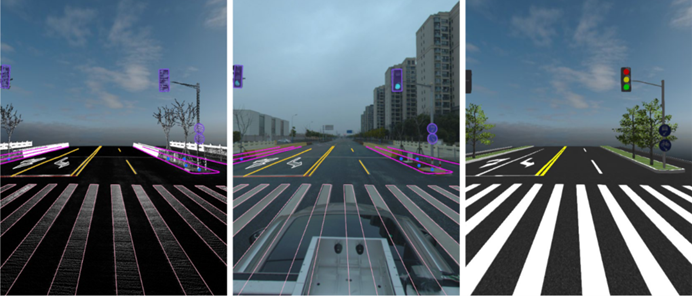
To support the safe operation, maintenance, and full life-cycle management of transportation infrastructure such as roads and railways, the research group carries out research on intelligent inspection based on the integration of LiDAR, imaging sensors, and artificial intelligence algorithms. Relevant work covers three-dimensional data acquisition for transportation infrastructure, recognition and modeling of key components, asset inventory, and condition assessment. It also includes systematic studies on high-definition map construction, road distress detection, railway facility inspection, and digital twin modeling. By establishing a complete technical workflow from point cloud processing and feature extraction to product generation and visualization, the group is promoting the transition of transportation infrastructure management from conventional two-dimensional graphical representation toward reality-based and intelligent solutions.
For typical application scenarios including transmission systems, distribution networks, substations, and renewable energy plants, the research group conducts research on intelligent inspection of power infrastructure and spatial risk perception. Research topics include collaborative acquisition of multisource sensing data, detection of hazard targets in transmission corridors, intelligent analysis of equipment condition, operational simulation and early warning, multitemporal change detection, and refined inspection path planning. By integrating LiDAR, imaging, point cloud processing, and three-dimensional visualization and analysis, the group is building an integrated technical framework covering acquisition, processing, recognition, analysis, and application. This framework provides support for the digital management, intelligent inspection, and risk early warning of power infrastructure.